Short answer
With the power off at the breaker and the wires off the element, a multimeter across the two element screws should read close to the expected resistance: volts squared divided by watts. A 4,500 watt, 240 volt element works out to about 12.8 ohms; an open circuit (no reading) means it is burned out. Replace it with the same watts, volts and mounting type printed on the old one, and refill the tank before turning power back on.
Signs of a bad element
- No hot water: often the upper element or upper thermostat.
- Lukewarm water, or hot water that runs out fast: often the lower element.
- Breaker trips: an element shorted to the tank. Test for continuity between each screw and the element’s metal base.
Test an element
Power off
Switch off the heater’s breaker. Remove the access cover and insulation, and confirm the terminals are dead with a tester.
Free the element
Disconnect one wire from the element so the meter reads only the element.
Read resistance
Set the meter to ohms and touch the two element screws. Compare with volts squared divided by watts, using the numbers stamped on the element.
Check for a short
Touch one probe to each screw and the other to the element’s metal base. Any reading means it is shorted and must be replaced.
Resistance = volts squared / watts
| Element (240 V) | Expected resistance |
|---|---|
| 3,500 W | About 16.5 ohms |
| 4,500 W | About 12.8 ohms |
| 5,500 W | About 10.5 ohms |
Choose the replacement
-
01Most common
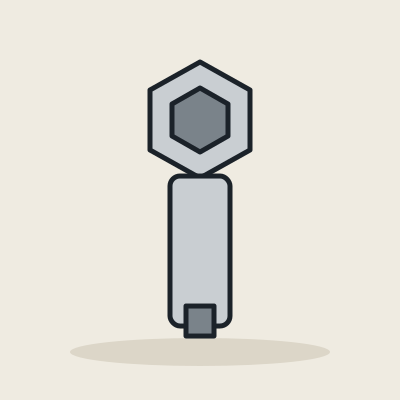
Screw in element
Best for: most home electric tanks
- Mount
- 1 in screw in
- Match
- Watts and volts on the old element
- Tool
- Element wrench
- Match the watts and volts exactly
- Low watt density versions run cooler, a good choice with hard water
- Comes with a gasket: use the one in the box
What you need
Replace it
With power off and verified: shut the cold supply, open a hot tap, and drain the tank below the element (see how to flush, which drains the same way; it is a good time to flush). Unscrew the old element with the element wrench, clean the threads and seat, fit the element with its gasket and snug it. Close the drain, open the cold supply with a hot tap running until water flows steadily, check for leaks, refit the wires, insulation and cover, then restore power.
Elements fail faster with heavy sediment. Flushing yearly and checking the anode rod help both.
Questions people ask
How do I know which element is bad?
No hot water at all usually points to the upper element or its thermostat, because the upper element heats first. Hot water that runs out fast usually points to the lower element. Test both with a multimeter.
What ohms should a water heater element read?
Resistance equals volts squared divided by watts. For 240 volts: 3,500 watts is about 16.5 ohms, 4,500 watts about 12.8 ohms, 5,500 watts about 10.5 ohms. A reading of zero or infinite means a bad element.
Can I replace a water heater element without draining the tank?
Some people do it with the cold supply off and a hot tap closed to hold a vacuum, but water still comes out. Draining below the element is the safer, cleaner way.
What happens if I turn on the power with the tank empty?
The element burns out within moments in air, a dry fire. Always refill the tank fully, with a hot tap running steadily, before restoring power.
Last reviewed October 29, 2026. Models, codes and listings change; check your heater’s manual and your local code, and follow the maker’s instructions.